


Walk into almost any NHS trust, council office or head-office kitchen and you’ll find one: a “you said, we did” board. Two columns, a handful of laminated cards, a quiet promise that feedback here goes somewhere. It’s one of the better ideas in people management. It’s also, in most workplaces, quietly not working.
Why “you said, we did” matters more than the survey
Most organisations have got reasonably good at asking. Pulse questions, engagement surveys, suggestion boxes, the odd focus group. The step that decides whether any of it was worth doing is the one that comes after: telling people what changed because they spoke.
The CIPD’s employee voice research puts a number on what happens when that step is missing. A quarter of employees report high levels of silence — they have things to say and choose not to say them. Not because they can’t, but because they’ve learnt it doesn’t lead anywhere. Every unanswered survey teaches that lesson again.
A “you said, we did” habit is the antidote. It’s the visible proof that listening was real, and it’s the reason the next survey gets honest answers. We wrote about the mechanics of turning feedback into action before; this is about the last mile — making sure people actually see it.
Where the board falls down
We’re fans of the idea. We’re less convinced by the noticeboard, and if you’ve ever been the one updating it you’ll know why.
It’s in one place. Your shift workers, your field team, the person who’s been remote since 2020 — none of them walk past the kitchen. A physical “you said, we did” board reaches whoever happens to be in the building, on that floor, looking in that direction.
It goes stale. Most “you said, we did” boards get updated when someone remembers. Three months on, the “we did” column is still celebrating the new coffee machine, and everyone has stopped reading it.
It’s one-way. The board tells people what happened. It can’t tell you whether they think it was the right call, whether it went far enough, or whether there’s a follow-up. The conversation stops exactly where it should get interesting.
It’s unmeasured. How many people saw it? Which teams? Did the night shift ever find out? A board can’t answer any of that, so you’re running the most important step of your feedback process on a hunch.
None of this is a reason to drop the practice. It’s a reason to move it somewhere people already are.
What “you said, we did” looks like in an app
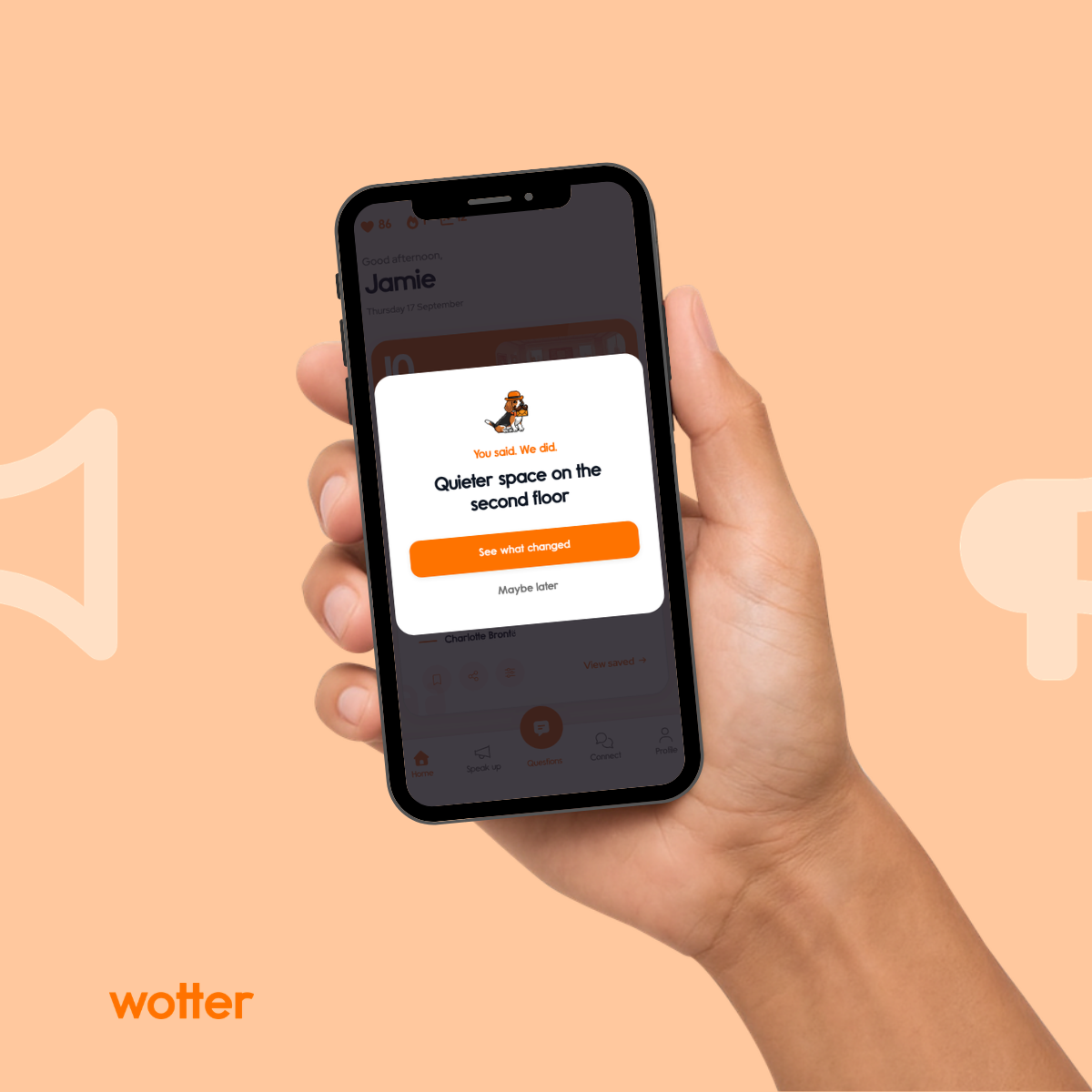
We’ve just shipped this in Wotter, so here’s the version we built — partly to show what’s possible, mostly because it’s the concrete example we know best.
It arrives, rather than waits. When you post an update, employees get a prompt the next time they open the app: the title, and a “see what changed” button. No hunting for the board, no all-staff email that gets buried by lunchtime. A card on the home screen keeps the latest update in view, with a count of anything they haven’t opened.
People can answer back. Every update takes a thumbs up or down, and comments — anonymously, the same way all Wotter feedback works. That anonymity matters here. “We’ve changed the rota” will get a polite nod in a meeting and an honest reaction in an anonymous comment. The honest one is the useful one.
You choose how open the comments are. Let everything through, hold comments for approval, or turn them off for the sensitive ones. On the Wottsby tier the AI screens comments first: anything constructive goes straight up, anything abusive or off-topic waits for a human. Employees can report a comment they don’t like the look of, and reported ones surface in a review list for HR.
You can see who it reached. For each update: how many people opened it, what share of the company that is, how that grew day by day, and which teams or locations it reached — with small groups folded together so nobody’s identifiable. The ones that don’t land are as useful as the ones that do. If the warehouse team never opened the update about the warehouse, that’s a comms problem you now know about.
Writing a “you said, we did” update that lands
The tool is the easy half. What makes the practice work is what you put in it, and the same rules apply whether it’s a board, an email or an app.
Quote the “you said” properly. “You told us the 9am start doesn’t work around the school run” is a real thing a real person said. “Colleagues raised concerns about flexibility” is HR-speak nobody recognises as their own. Use the words people used — that’s what makes them feel heard.
Be honest about the “we did”. If you’ve fixed it, say so. If you’ve fixed part of it, say which part. If you’ve looked at it and decided not to change it, say that too, and why. A “you said, we didn’t — here’s why” update builds more trust than silence, and far more than a vague “we’re looking into it” that never resolves.
Post the small things. A fixed printer, a quieter meeting room, a rota tweak for one team. These take five minutes to write up and they prove the loop works. If people only ever see the annual big-ticket announcement, they’ll assume the small stuff went nowhere.
Keep the cadence. The board’s fatal flaw was going stale. Aim for something every couple of weeks, even if it’s minor. A steady trickle of “we did” does more for trust than one grand reveal a year — the same logic that makes continuous feedback beat the annual survey.
Read the comments. If an update draws twenty comments saying “great, but what about Leeds?”, that’s your next update writing itself.
The loop is the point
Asking is cheap. Listening is harder. A “you said, we did” habit is how you prove the second one happened. Proving you listened is the bit almost everyone skips — and it’s the bit that decides whether people bother next time.
It’s a simple habit with an outsized return. Just don’t leave it on a wall.